Transnational history of education reform in modern China
中国近现代教育改革的跨国史
I research how progressive educational ideas travelled, were received, and were remade in early Republican China, with particular attention to mid-level teachers, professional networks, and the micro-politics of reform.
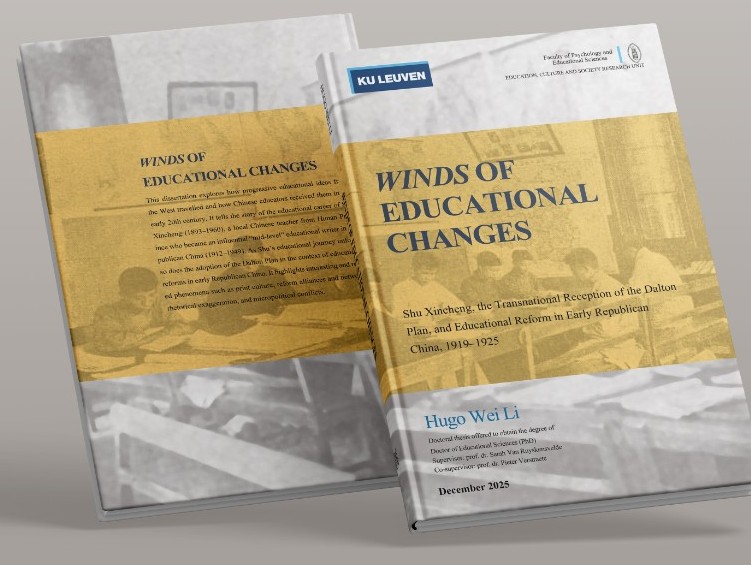
Winds of Educational Changes: Shu Xincheng, the Transnational Reception of the Dalton Plan, and Educational Reform in Early Republican China, 1919–1925.
教育变革之风:舒新城、道尔顿制的跨国接受与民初教育改革(1919–1925)。
Supervisors: Prof. Sarah Van Ruyskensvelde and Prof. Pieter Verstraete (KU Leuven).
导师:Sarah Van Ruyskensvelde 教授、Pieter Verstraete 教授(鲁汶大学)。
This research was fully funded by a scholarship from the Research Foundation – Flanders (FWO).
本课题获得比利时弗莱芒政府研究基金(FWO)全额奖学金资助。
Abstract
内容简介
This dissertation explores how progressive educational ideas from the West travelled and how Chinese educators received them in the early 20th century. It tells the story of the educational career of Shu Xincheng (1893–1960), a local Chinese teacher from Hunan Province who became an influential "mid-level" educational writer in Republican China (1912–1949). As Shu's educational journey unfolds, so does the adoption of the Dalton Plan (a US-American educational approach that gave students greater freedom and individual guidance from teachers) in the context of educational reforms in early Republican China. It highlights interesting and related phenomena such as print culture, reform alliances and networks, rhetorical exaggeration, and micropolitical conflicts.
Rather than a simple "copy‑and‑paste" from "West" to "East", the study shows a negotiated process. Global ideas arrived through journals, lectures, personal correspondence, and professional networks. Local realities — crowded classes, scarce resources, workplace conflicts, and teachers' personal ambitions — pulled in the opposite direction. In the middle stood "mid-level" educators like Shu, who translated reforms for colleagues and tried them out in real schools for "grassroots" teachers.
By tracing Shu's career from classroom to print culture, the dissertation explains why the Dalton Plan first drew excitement and then lost momentum. The same networks that spread "progressive" ideas also favored quick, eye‑catching slogans over slow, structural change. Over time, this gap between promise and practice led Shu — and many of his contemporaries — to temper their early optimism.
The study's broader message is that educational change depends not just on "big names" or national decrees, but on the local and everyday choices of "mid-level" actors, their ambitions, and the conditions in which they work. Modernization, in other words, is a story of human and human interactions: ideas travel, but groups of people together contribute to what they become.
Marginalized Brokers of Reform? Transnational Knowledge Circulation and the Micropolitics of Progressive Educational Reform in 1920s China边缘化的改革中间人?跨国知识流通与1920年代民国进步主义教育改革中的微观政治学— History of Intellectual Culture (De Gruyter, forthcoming)— History of Intellectual Culture(即将见刊 2026)